Announcing the AI for Science Fellowship
The Horizon Institute for Public Service, Renaissance Philanthropy, SeedAI, and Fulcrum Science are partnering to launch a fellowship that embeds technical AI talent across the national labs to help advance the goals of the Genesis Mission, the Department of Energy’s flagship science and technology initiative.
The application deadline is July 31. The fellowship will last 9–12 months starting in fall 2026, with a prorated annual compensation of $200,000. Fellows can work remotely or in person at their national lab. Applicants should have at least 2 years of applied AI experience.
The AI for Science Fellowship
AI is reshaping what’s possible in science. In a relatively short span, AlphaFold cracked the protein folding problem and transformed biology, with far-reaching implications for drug discovery and other life-saving applications. Today, similar breakthroughs are within reach across energy, materials, and beyond.
Much of the coming wave of scientific discovery will run through the Genesis Mission, a flagship science and technology initiative launched by the Department of Energy in late 2025. The initiative identifies 26 national science and technology challenges that are critical to US leadership. It also envisions a national platform that will connect the world’s best supercomputers, experimental facilities, AI systems, and unique datasets, with the department’s 17 national labs playing a key role.
To help realize this vision, AI for Science Fellows will be forward deployed to DOE national labs to bring frontier AI expertise to some of the country’s highest-priority scientific challenges. As core members of the technical staff on a Genesis Mission project, fellows will work alongside national lab scientists and partners and apply AI to national priorities—from building cutting-edge models of plasma dynamics in pursuit of controlled fusion, to advancing state-of-the-art models for foundational materials discovery.
The fellowship will last 9–12 months starting in fall 2026, with a prorated total annual compensation of $200,000. Fellows are expected to travel to their national lab site at least once a quarter, but may work on-site if they prefer. Initial national lab partners include Idaho National Laboratory, Brookhaven National Laboratory, and the Princeton Plasma Physics Laboratory; additional partners may be announced later.
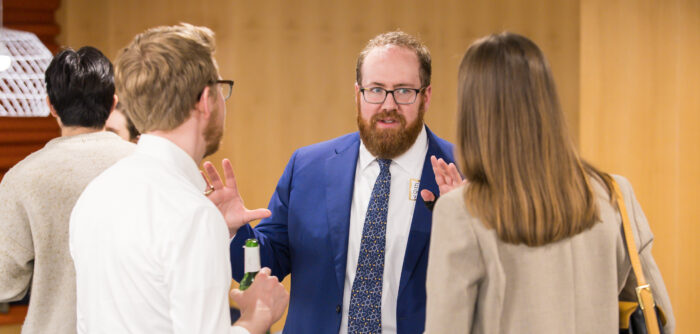
For more background on the AI for science opportunity, DOE and the national labs, and what it’s like to apply your technical skills to public missions, check out this Q&A with some of the fellowship’s organizers:
Eligibility
Competitive applicants should have at least 2 years of industry experience building AI models or agents. Applicants with industry experience building AI applications or data infrastructure will also be considered.
Scientific domain experience or expertise is not a requirement, but fellows should expect that any placement will require some training and study in a specific scientific discipline or energy topic. This will be done with support from expert colleagues at your host institution.
All fellows must be eligible to work in the United States for the duration of their placement. We are not able to sponsor US employment visas; US permanent residents (green card holders) are eligible to apply.
Application process and timeline
Our initial application form asks for the following items:
- A CV or resume (≤ 2 pages)
- A series of short-answer questions on your motivations and experiences (≤ 200 words)
After the initial submission, successful applicants will complete a series of interviews through our partner organizations and national labs. Selected fellows will be matched to partner national labs based on their scientific domains of interest and national lab partner availability.
- Application deadline: July 31, 2026
- Final fellow selection: August-September 2026
- Expected start date: Fall 2026
We are committed to using evidence-based best practices in our application and review process to promote merit-based selection, including blind grading of application materials.
Fellowship FAQs
Yes. This is a full-time position and is expected to be your sole professional commitment for the duration of the fellowship. Fellows are not permitted to take on other work while in the role.
The fellowship runs between 9 and 12 months, with the exact length depending on the fellow, project, and placement.
This is a fully funded fellowship. Total compensation is up to $200,000 across salary and benefits for a full 12-month term, prorated for shorter terms (roughly $150,000 for a 9-month placement). Funding for the fellowship is provided by the Horizon Institute for Public Service, Fulcrum Science, and Renaissance Philanthropy.
Fellows are hired through the Horizon Institute for Public Service. Horizon is the employer of record; the fellowship is run in partnership with Renaissance Philanthropy, Fulcrum Science, and SeedAI.
The role is largely remote. The one requirement is an on-site visit to your assigned national lab, likely once per quarter (to be agreed with your placement lab). Fellows who would like to live near their project site are welcome to, but relocation is not required.
This is a general application — you don’t apply to a specific lab or project. Applicants are interviewed for the projects best suited to their background, matched against the interests and needs of the participating research labs. Project scopes are expected to be finalized by the time applicants would receive an offer (August-September 2026).
The expected timeline is as follows, though specific dates may be contingent on the timing of DOE Genesis Mission funding:
- Project scope finalized: end of July 2026
- Interviews and further assessment: throughout August-September 2026
- Start date: Fall 2026, with some flexibility
We’re looking for private-sector technical AI talent who want to bring their skills to a public scientific mission. The core bar is at least two years building foundation models or working hands-on with modern AI systems. No specific scientific or policy background is required. A scientific domain interest and/or a PhD are both pluses but not required.
No. Government security clearance is not required for this fellowship.
Initial national lab partners include Idaho National Laboratory, Brookhaven National Laboratory, and the Princeton Plasma Physics Laboratory. Projects span areas like AI for nuclear reactor operation and design, accelerating plasma physics simulations, and power grid optimization. Your match with a host institution and project will be finalized as part of your fellowship offer and acceptance.
The fellowship does not currently include opportunities for extension. Host institutions may be interested in keeping you on, and your experience will be relevant to many other “AI for science” projects. You will be connected to AI for science networks as part of the fellowship.
The fellowship is only available to those who do not need visa sponsorship. This includes US citizens and green card holders.
The application deadline is July 31, 2026 at 11:59pm PT.